Is your organization prepared for the next cyberattack?
Last week, Bol reported a cyberattack at its logistics provider. Shortly after, similar notifications followed from de Bijenkorf, Ajax, and eyewear brand Ace & Tate, all of whom informed their potentially affected customers by email about the same incident at their shared logistics partner. That’s a perfectly sound and logical way to inform customers. But it raises another, equally important question: how do you communicate internally fast enough in a moment like this, so your own people aren’t caught off guard by something they didn’t yet know?
What this incident also shows: these companies’ own systems weren’t affected. The attack happened at a partner. That’s exactly the risk you need to be aware of. Your own security, processes, and communication can be entirely in order, and you can still end up in a crisis the moment a partner somewhere in the chain is hit. For your customers, that makes no difference, they just call you. Which means the employees who deal with customers every day need to be just as well informed as they would be if the incident had happened within your own organization.
A message was sent, but did it actually land?
During an incident, most of the attention goes outward: the press release, the customer email, the notification to the regulator. That makes sense, since there’s often a legal deadline attached. But while that external message goes out, part of the organization is already reading the same news via social media or a news site, or hearing about it through a message from a colleague, before anything has been shared internally. It’s exactly the people who deal with customers, such as customer service or the colleague at the counter, who need that internal message the most. They get the questions first, and if they hear the news later than the customer does, they’re left standing there without an answer. Not because they’re incompetent, but because nobody let them know in time what was going on, and what they could and couldn’t say.
What makes crisis communication different
According to the NCTV, the Netherlands’ national coordinator for counterterrorism and security, good crisis communication means “distributing accurate, timely, and understandable information during and about a crisis, disaster, or incident.” But can you actually do that when a crisis unfolds within your own organization, such as a data breach, an outage, or a cyberattack? That calls for different tools than your regular internal communication. Regular communication works fine as long as there’s time, and in a crisis, that time simply isn’t there.
The difference mostly comes down to what people need in that moment. With everyday internal communication, there’s time: a message can arrive calmly and be read whenever it’s convenient. Crisis communication is built around three things that can’t wait. People need to know exactly what’s happening, so they don’t fill in the blanks themselves, usually with an assumption worse than reality. They need accurate, understandable information on time, even if the answer is still “we’re investigating.” And they need to know what they should, or shouldn’t, do themselves, so they don’t take unnecessary risks or say the wrong thing to a customer.
That’s exactly why a newsletter or an intranet post falls short during a crisis. Those tools are built to be read whenever it suits someone, depending on someone happening to visit the right place at the right moment, and that’s precisely what you can’t guarantee in a crisis.
From reactive to proactive
The difference between an organization that gets caught off guard and one that stays ahead isn’t in what’s said, but in how fast and how confidently it’s said.
- Sequence. Reactive communication means you’re chasing the external news. Proactive means your internal message is ready before the external one goes out, or at least at the same time.
- Speed over completeness. A short, factual message right now is worth more than a complete story an hour later.
- Everyone, not just people at a desk. Non-desk employees deserve the same speed of information as headquarters.
- Knowing, not assuming. Sending a message isn’t the same as knowing it’s been seen.
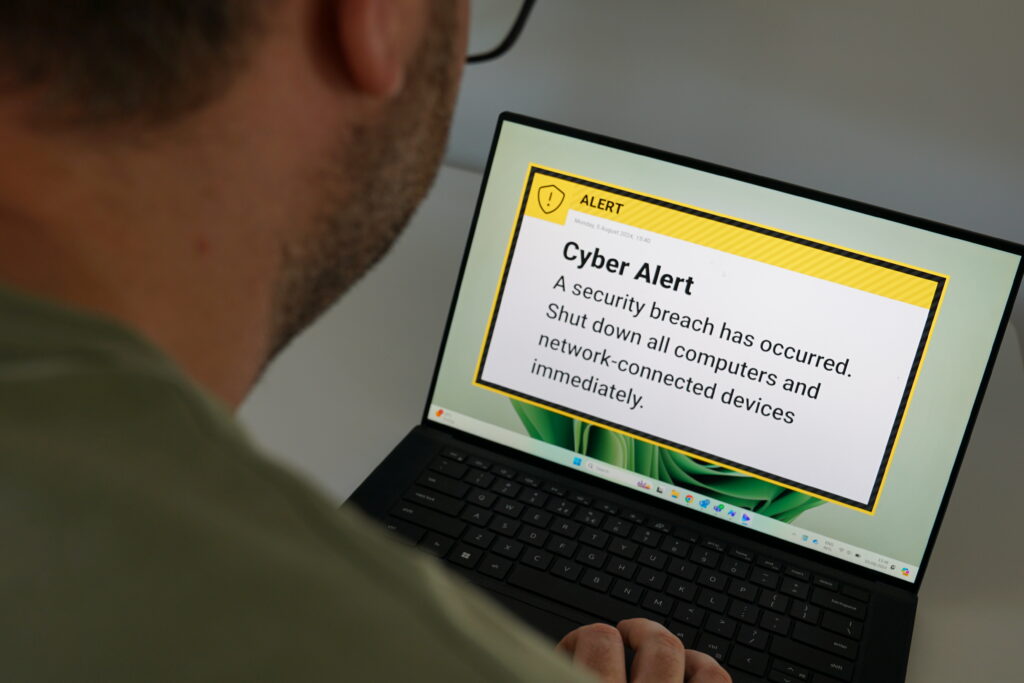
Seen by everyone, the moment it matters
In This is exactly what Netpresenter is built for: making sure an important message isn’t just sent, but actually seen, across the entire organization, right when it’s needed.
The Desktop Ticker keeps up-to-date information constantly visible, similar to the breaking-news bar you know from a television broadcast: short, eye-catching, and impossible to miss, even when someone’s focused on something else. A Desktop Alert with a pop-up goes a step further and actively interrupts whatever someone’s doing, so an urgent message doesn’t get lost among other notifications. Add a CTA button that lets someone confirm they’ve read the message with one click, and you instantly get statistics and an overview of who has seen it and who hasn’t, instead of having to assume.
For people who aren’t at a screen, an SMS message is the channel that still reaches them directly, whether on the floor, behind the wheel, or on a night shift, and even when the internal network itself is unavailable. With the targeting feature, you don’t send everyone the same message: customer service gets the concrete answers they need, while the rest of the organization gets a brief status update. And with alerts based on pre-set scenarios, you don’t have to figure out in the moment who to reach and how, that’s already been decided, so all that’s left is to press the button.
Are you prepared?
The next incident won’t announce itself in advance. So the question isn’t if, but when, and whether your organization will be ready: can you inform your own people faster than the news that reaches them through social media or a message from a colleague? Want to know how Netpresenter can help you with that, so you’re prepared for the moment you need to reach everyone quickly? Get in touch with us.