Real Stands Out: How Authentic Digital Signage Gets Your Message Noticed
Here is a finding worth pausing on. In the 2026 Bentley University-Gallup survey, nearly half of Americans (49 percent) view businesses’ use of AI to create advertisements negatively, compared with 19 percent who view it positively. And they are seeing plenty of it: nearly eight in ten have come across ads in the past 30 days that looked like they were made with AI. Gallup’s bottom line: consumers appear willing to accept AI as a creative tool, but they are less comfortable when it replaces people’s images and voices. And how businesses use AI may influence what people think of those companies.
This is research about advertising, not about digital signage or internal communication. But it is a useful signal for anyone who talks to people through a screen. AI-made visuals are becoming more common, so it pays to know what to watch out for. Treat what follows as a friendly heads-up: some tips, and a look at how Netpresenter helps you create real, on-brand content in minutes.
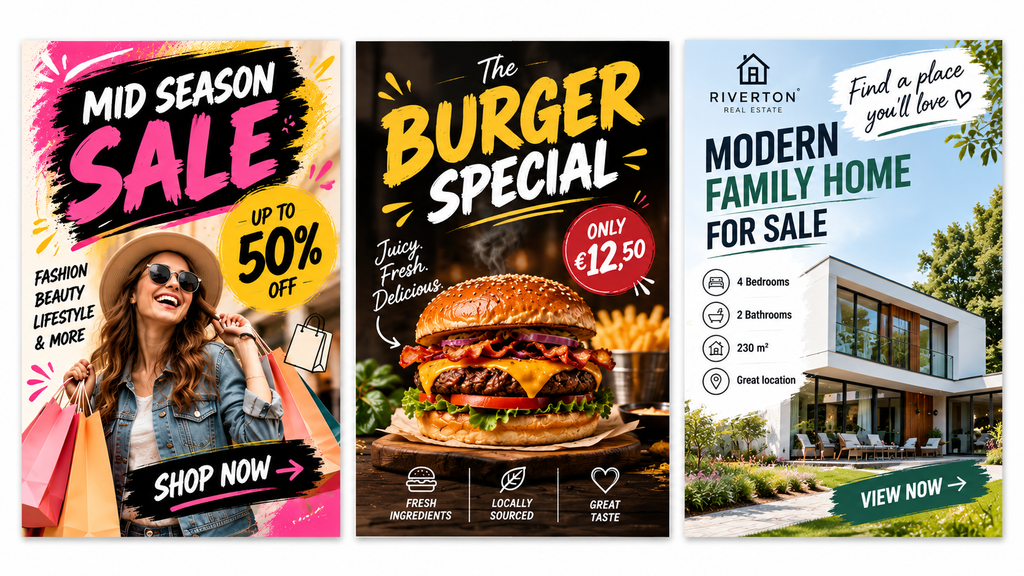
Too polished to be true
Our social feeds, shop windows and web shops are filling up with content that looks suspiciously alike: smooth, polished and a little too perfect. Coursera lists the signs as overly smooth or “plastic” textures, inconsistent lighting and a generic feel without a distinctive human element, and the result has picked up a nickname: “AI slop”. Slop once meant soft mud, later food waste or rubbish, and Merriam-Webster named it its 2025 Word of the Year. Even the dictionary has noticed.
It has also left the internet. TechRadar describes AI-made event posters and café window displays that all look alike, down to the same marker-style fonts. Cartoonist and scientist Dr. Maria Boyle points out the problem for organizations: when every event looks the same, they all end up with the same branding, and you can no longer trust AI art as a brand to signal quality.
Restaurant menus are a good example. The Guardian reports that diners increasingly meet AI-generated food images and find them unappealing and misleading, while restaurants say they are trying to cut costs at a time when food and labor prices are high. TechRadar’s story is the funniest of all: a café could not get the AI to make its mango granola look like the real thing, so it changed the granola to match the poster. That is what happens when marketing stops reflecting the actual business.
What this means for your screens
The reason is simple: people are being flooded with AI content. Gallup asked consumers about advertising, not employees about screens, so see this as a signal rather than proof. But it is a signal worth acting on. Your screens are the signboard of your organization, for employees and visitors alike, and what they show says something about you. If a slide feels generic or too good to be true, it is easy to imagine people skipping it or taking it less seriously, and the messages that matter, from safety rules to company news, may get lost on the way. A restaurant that turns to AI images to save money risks its guests’ trust. Companies that go generic on their screens could run a similar risk. The way out is to be authentic.
Stand out by being real
Authentic does not have to be complicated. A creative agency founder quoted by TechRadar says the best communication shows “something real about the people, products and values behind a business.” For your screens, that means your own workplace instead of an anonymous office, your own tone of voice instead of corporate filler, and a look that is recognizably yours. People are getting better at spotting generated visuals, and Gallup’s bottom line shows they are least comfortable when AI replaces real people.
And it means real people. A real, slightly imperfect photo of your own team beats a too-perfect AI image of people nobody knows, because they do not work there. Recognizability matters: everybody loves spotting a familiar face on the big screen, and seeing themselves and their colleagues back makes employees feel the message is meant for them. When it comes to trust, authentic usually beats perfect.
Enjoy AI, just don’t overdo it
AI is a wonderful tool for concepts, copy and creativity. It helps you find the right words, shorten a text so it fits on a screen, brainstorm ideas, and even create a supporting icon or mood image that fits your topic. An image says more than words alone, and it can help your text land faster. The only thing to watch is not to overdo it: let AI help you, and keep the final result recognizably yours. As Coursera advises, see its output as a starting point, check it, and place it in your own layout.
AI-generated posters also have plenty of places where they simply belong. They are handy for a neighborhood party invitation, a kid’s birthday or a garage sale poster, where nobody expects a corporate identity and a bit of fun is the point. For a company, a uniform brand matters more, because that is what makes your screens recognizable and trustworthy. The good news: you do not need to be a designer to get there.
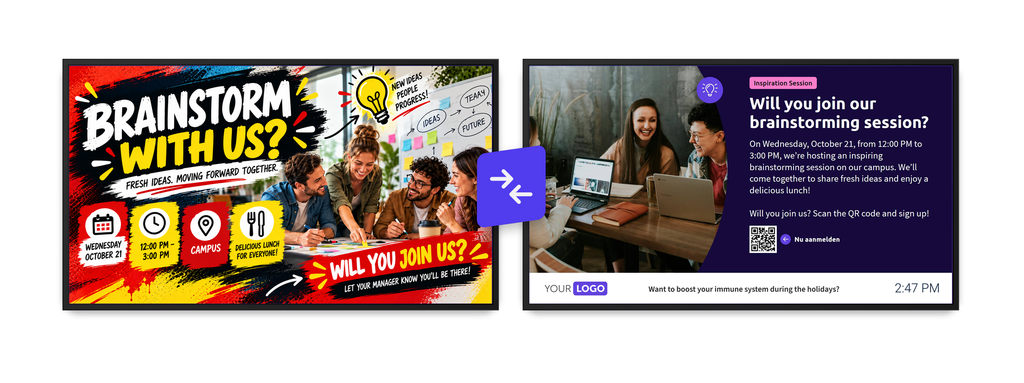
Making it easy with Netpresenter
That is where Netpresenter Digital Signage comes in. You can put authentic, professional content in your own corporate branding on your screens in no time, and anyone on your team can do it. No manual, no training: marketing, HR or the colleague at reception can publish a message in minutes.
It starts with the words. The built-in AI Assistant helps you write a good, compact text that is easy to read on a screen, so your message lands at a glance. You stay in charge and review the result before you publish. Then comes the look. Your logo, colors and fonts are applied automatically through Branding, so every message looks on-brand, whoever creates it. Ready-made Templates, combined with your branding, cover all kinds of content, from a birthday and an important announcement to the lunch menu or an event. Make it yours: add your own photos, a video or a GIF to your message, quickly and easily, to give it extra impact, and let colleagues recognize their own workplace and their own people on the screen.
Do you want to get started with professional, authentic content on your screens too? Discover more about our Digital Signage software or get a demo and see how easy it is.